Ch. 20 Further programming
20.1 Programming paradigms
What is meant by a programming paradigm
Characteristics of a number of programming paradigms:
- Low-level
- Various addressing modes: immediate, direct, indirect, indexed and relative
- Uses instructions from the computer’s basic instruction set
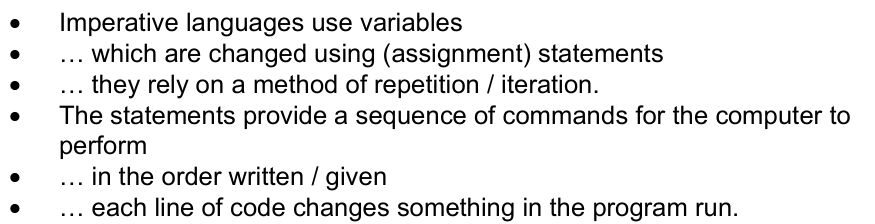
- Imperative (Procedural)
- Object Oriented
- Uses self-contained objects
- Containing programming statements (methods) and data
- A class is a template defining the methods and data of a certain type of object
- The attributes are the data items in a class
- A method is a programmed procedure that is defined as part of a class
- Putting the data and methods together as a single unit, a class, is called encapsulation
- When writing a program, an object needs to be declared using a class type that has already been defined
- Properties of an object are the data and methods within an object that perform named actions
- An occurrence of an object during the execution of a program is called an instance
- Data hiding protects the integrity of an object by restricting access to the data and methods within that object
- Inheritance is the process by which the methods and data from one class, a superclass or base class, are copied to another class, a derived class
- Polymorphism is when methods are redefined for derived classes
- Overloading is to use the method with a different number of parameters
- Containment/aggregation is the process by which one class can contain other classes
- Methods used during the life of an object can be constructors, setters, getters and destructors
- Constructor: a method used to initialise a new object
- Setter: a method used to control changes to any variable that is declared within an object
- Getter: a method that gets the value of a property of an object
- Destructor: a method that is invoked to destroy an object
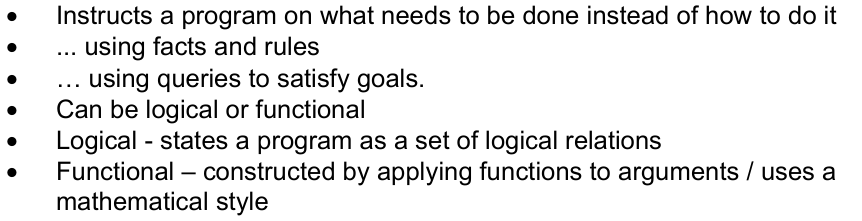
- Declarative
- Example: SQL
20.2 File processing and exception handling
Not in Paper 3 I guess